Sponge and biscuit
Do you remember the song?
« 🎵 It's not what you do that counts, it's the story, the story… 🎵 »
Well, here we are, I spent the day humming a version of it that got a little out of hand:
« 🎵 It's not what you say that counts, it's what you hide, what you hide… 🎵 »
(sorry, Monsieur Duteil)
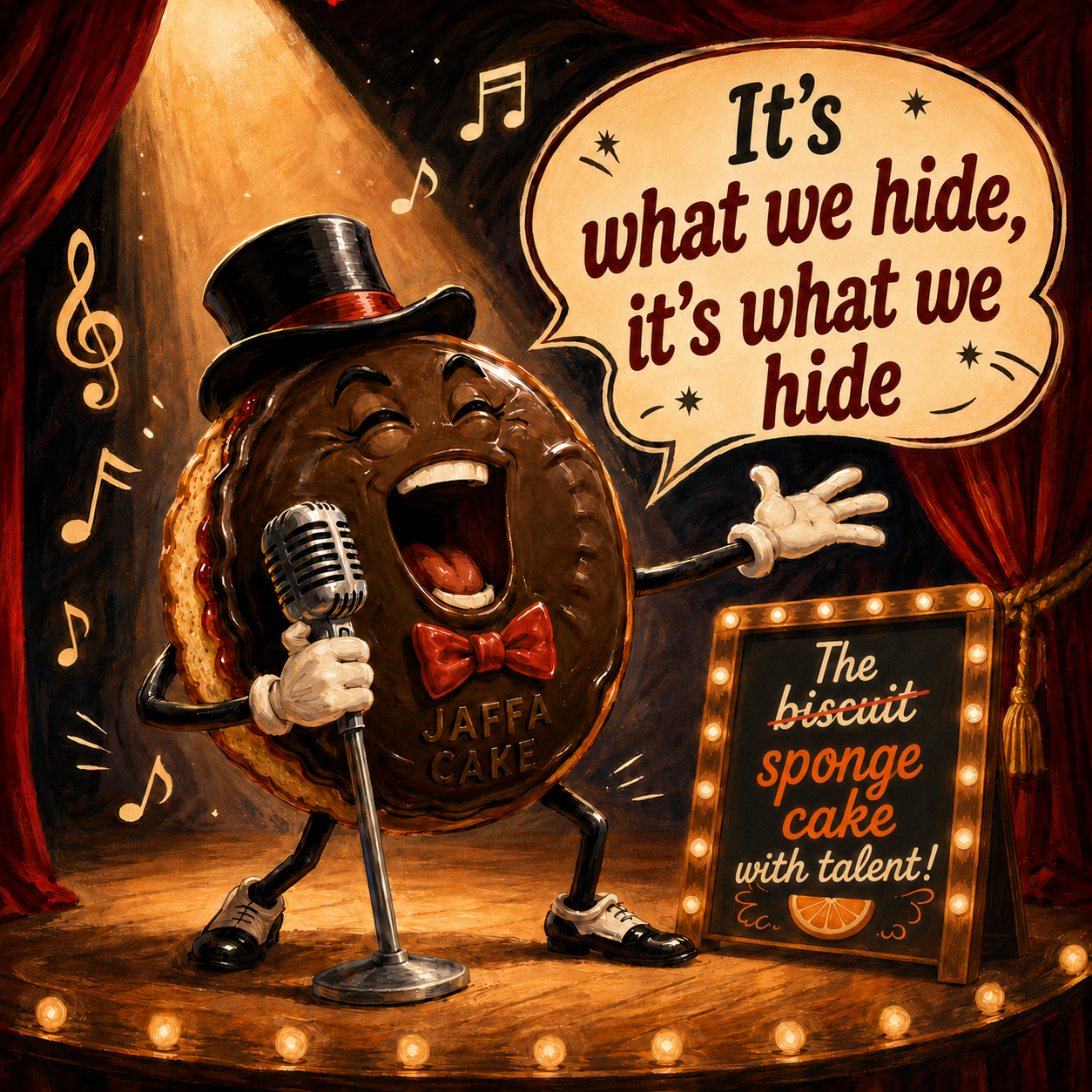
And all of it, you'll never guess, because of a biscuit. A stupid biscuit, and above all a stupid article.
But before we get to the article, I have to confess something. Those little discs of sponge, orange jelly and chocolate coating that my parents bought for our snack time… Let me just say it: as a kid, I'd swipe whole boxes of these Jaffa Cakes/Pim's, and sneak off to stash them in my room to scoff the lot in the afternoon. Mum would eventually find, under the bed, forgotten wrappers with two or three stale biscuits left at the bottom. It drove my parents up the wall. Anyway: hiding things (Jaffa Cakes especially), that I know a thing or two about. Which is probably why I'm so good at spotting when someone else is at it.
And, wouldn't you know it, someone was.
An Irish chef wrote a piece titled, I swear, "Jaffa Cakes: An Oblique History." "Oblique." Nice word. It sets the tone: we're not going to talk to you about the biscuit, we're going to talk to you about what the biscuit hides. And there, honestly, he had me. Because that's exactly the little tune that was going round in my head. You know the one.
First, credit where it's due
Let's be honest for two minutes (after that, I promise, we'll have some fun). The article isn't entirely a hack job. The biscuit really is named after the Jaffa orange. This orange, the shamouti, is a genuine marvel. Born near Jaffa before 1844, spotted and grafted by Arab growers1, shipped to Europe by the boatload while nobody back home could place it on a map. That's true, it's beautiful, and the article is right to tell it. It even notes, very honestly, that McVitie's chose the name "not because they were using them, but because of what they evoked"2. No biscuit-stolen-from-the-Palestinians. The author plays fair.
And then Jaffa falls in 1948, its population drops from 70,000 to a few thousand3, the groves change hands4, the "Jaffa" brand outlives the people of Jaffa. All of it is accurate. I don't take back a word. And yet, under a perfect rind, there are always a few pips.
The problem isn't what the article says.
(You see where I'm going. Sing along.)
🎵 It's what you hide, it's what you hide 🎵
"Oblique," then. The trouble with an oblique angle is mostly the blind spot it creates. Here's the thing: in this whole article about the Jaffa orange, the Jewish grower never grows in a grove. The Zionist, McMahon does show: he appropriates the orange-as-symbol, and he turns up, at the very end, in 1948, rifle in hand. But who planted, grafted, exported on the Jewish side? Silence. That grower doesn't exist in his text.
But the Jaffa orange, my friends, is also a story of Jewish growers. And no minor detail:
- As early as 1878, Jewish pioneers found Petah Tikva. Then Rishon LeZion in 1882, Rehovot in 1890. All three would become capitals of the Jewish orange5.
- Baron Edmond de Rothschild funds these moshavot from the 1880s onward6. (Yes, that Rothschild. The family that already fuels half the crackpot theories of your colleagues at the office.)
- In 1902 the Pardess cooperative is born, "orchard" in Hebrew. The word is a distant cousin of our "paradise" (both come from Old Persian): for a citrus cooperative, hard to aim higher. It will export the orange under a Jewish label7.
- And the kicker: on the eve of the war, in 1939, Jewish and Arab groves split the acreage roughly evenly, and half the oranges exported from Palestine come out of Jewish groves8, while Jews are only a third of the population and own just 6-7% of the land9. (Yes, I went and dug up the official 1946 British Mandate report. For a biscuit. We all have our hobbies. Mind you, at least I like the biscuit: the author, for his part, wrote a whole article about a biscuit he doesn't even enjoy.)
So there you have it. An article called an "oblique history," promising to reveal what you haven't been told… forgets precisely the half that inconveniences it. The orange was the symbol of both peoples, and the article keeps only one. It isn't a lie. It's a chosen silence, which is cleverer. 🎵 It's what you hide, it's what you hide 🎵.
The mote, the beam, and the orange
Except the article doesn't stop at the omission. It carries on to 1948, and that's where I burst out laughing on my own.
McMahon recounts how the young State of Israel appropriates the orange, raises it to a national icon, and, I quote, builds its citrus industry "on the groves established by Palestinians." Then come the posters, the brochures, the orange grove brandished as a feat of national genius, "while omitting the pre-1948 Palestinian role."
Read that last bit again. "While omitting the pre-1948 Palestinian role."
(Hang on. Who's the one omitting a pre-1948 role here?)
Let's take it in order, because there are three layers, like the Jaffa Cake, and each one is juicier than the last.
One. "Built on the groves established by Palestinians." And it's true. Well, half-true. True, because Israel really did take over thousands of Palestinian groves whose owners had just fled or been driven out: as we said earlier, the groves change hands. But only half, because it already had as many of its own: in 1939, half the oranges exported from Palestine came out of Jewish groves8. The Israeli industry is built on both, its own sector and the one it seized. McMahon shows only one. And notice the shift: until now, he merely kept the Jewish half quiet; here, he doesn't keep it quiet anymore, he erases it, by passing off a half-truth as the whole story.
Two. The article blames the Israeli posters for erasing the Arab grower. And it's right: they did. The myth of the orange grove as proof of Zionist genius genuinely erased a century of Arab citrus growing. Only, to denounce that erasure… the article commits its exact twin. Remember: in his text, the Zionist appropriates the symbol and takes up the rifle in 1948, but he never plants a tree. It blames the other side for the omission it's signing itself. 🎵 It's what you hide 🎵, it turns out, sings both ways.
So yes: the iconography of the orange fed a myth, that of a desert Palestine waiting only for hands to make it bloom again10. But a text that grants the Jew the symbol and the rifle, never the spade, feeds the exact opposite myth. Two posters, two erasures. The same gesture.
Three, and it's the best, because the gun goes off in his own hand. To back up his point, McMahon calls a witness to the stand: the Palestinian historian Mustafa Kabha. He's the one who picks him, he's the one who brings him in. He gets a nice anecdote out of him, the flag one: before 1948, Kabha recounts, many already dreamed of seeing the orange on a future national flag. Lovely. And perfectly true. Except that this same Kabha is the author of a whole book on the orange of Palestine, and that book tells precisely the half the article passes over in silence. McMahon calls his own witness, takes the line that suits him, and snaps the book shut just before the page that demolishes him.
Grey isn't necessarily the middle
Here's that page. Kabha co-wrote his book with an Israeli historian, Nahum Karlinsky11. A Palestinian and an Israeli at the same table. And what they dig up there suits neither camp's narrative: for seven years, from late 1940 to 1948, the Arab and Jewish orange growers ran their industry together, within a single official body, the Arab-Jewish Citrus Control Board. The two authors admit they were surprised themselves that it held so long.
Grey isn't about setting everyone against each other. It's about refusing to let a complicated reality fit on a slogan. In what reaches me, the tidy versions omit, and almost always in the same direction. This article is a textbook case. The answer isn't to pick the opposing team; it's to put back what was taken out, including when it bothers me. And to say plainly that a story simple enough to fit on a flag isn't merely false: it's useless for understanding, and therefore dangerous. Whether the one who simplified it did so out of laziness or calculation changes nothing about the damage.
So, the Jaffa Cake?
Apparently the British tore into each other for years over whether it was a cake or a biscuit. I'll spare you: it's the one passage of the article that, for its part, really is of no interest. That said, for a biscuit that can't decide between cake and biscuit to presume to settle a century of history, well, the nerve of it. But the image I do like: a thing you can't file on one side or the other.
Like this story, come to think of it. Neither all white nor all black. Sponge and biscuit. Arab orange and Jewish orange. And a little song that was really saying that the story we tell wins out over the facts.
It's not what you say that counts.
🎵 It's what you hide, it's what you hide 🎵 🍊
Léon M. Degrauwe
The little notes (for those who want to check)
Because to fault an article for what it hides, without showing my own sources, would be a bit rich.
Footnotes
-
The Jaffa orange (shamouti variety) appeared before 1844 in a grove near Jaffa, probably as a bud mutation ("limb sport") of a local-variety (beledi) orange tree, then propagated by grafting. Its commercial name was "Jaffa orange." Sources: University of California, Riverside, Citrus Variety Collection, "Shamouti" (after Oppenheim, 1927 & 1929); Nahum Karlinsky, California Dreaming, SUNY Press, 2005 (repr. 2012), p. 16. ↩
-
JP McMahon, "Jaffa Cakes: An Oblique History," Substack, March 2025. The phrasing is taken from the article itself: the name was supposedly chosen for what the orange evoked, not because any went into the biscuit. ↩
-
Benny Morris, The Birth of the Palestinian Refugee Problem Revisited, Cambridge University Press, 2004, pp. 211-212. At the launch of the assault of 25 April 1948, "two thirds" of the pre-war population (estimated between 70,000 and 80,000) were still in place; only a few thousand (~4,000) remained by mid-May. ↩
-
Absentees' Property Law 5710-1950 (14 March 1950): its section 14 specifically targets citrus groves ("citrus grove") handed over by the Custodian of Absentees' Property. This is the legal framework by which the abandoned groves change hands. ↩
-
Founding of the moshavot: Petah Tikva 1878, Rishon LeZion 1882, Rehovot 1890. Oranges did not dominate there from the founding: Petah Tikva, "cradle of Jewish citrus growing" (private), saw its first private groves only in 1894. Source: Nahum Karlinsky, California Dreaming, SUNY Press, 2005 (repr. 2012), p. 52 (the founding dates belong to the general history of the First Aliyah). ↩
-
Baron Edmond de Rothschild financed the moshavot of the First Aliyah from 1882-83, but citrus was not central there: their flagship industry was viticulture (wine). His role in citrus was mainly indirect: infrastructure (roads, water), agronomists and know-how, which made the expansion of the groves possible. Source: Nahum Karlinsky, California Dreaming, SUNY Press, 2005 (repr. 2012), pp. 51 and 100. ↩
-
The Pardess cooperative ("orchard"), founded in the 1902/03 season (28 members originally, under the direction of Shimon Rokach), marketed the citrus of Jewish growers without going through the Jaffa merchants. Source: Nahum Karlinsky, California Dreaming, SUNY Press, 2005 (repr. 2012), p. 194. ↩
-
A Survey of Palestine, memorandum prepared by the Mandate government for the Anglo-American Committee of Inquiry (Dec. 1945 to Jan. 1946), vol. I, chapter IX. Acreage: "by 1939, when the area totalled some 293,000 dunums, both Arab and Jewish areas were roughly equal" (§58, p. 336). Exports: "In 1938/39 the export of citrus amounted to some 15,000,000 cases of which approximately one-half was from Jewish groves" (§177, p. 380); the §177 table puts Jewish groves at 155,000 dunums in 1939 (~53% of the ~293,000). Corroborated by Jacob Metzer, The Divided Economy of Mandatory Palestine, Cambridge University Press, 1998. ↩ ↩2
-
Figures from the Survey of Palestine, vol. I. Population: end of 1944, about 554,000 Jews out of ~1,765,000 inhabitants, roughly a third (p. 143). Land: as of 31 December 1945, Jews owned about 1,588,000 registered dunums (§52, p. 243), or ~6% of the total area (~26.3 million dunums); this figure does not include land they occupy without registration in their name, hence the 6-7% range. Consistent with the Village Statistics 1945. ↩
-
The myth is documented on two levels. Its structure, in Amnon Raz-Krakotzkin: the Zionist "return" narrative casts the pre-1948 land as "empty and out of history prior to their return" (p. 38), the "return" meaning "the obliteration of the history of the land and the existence of its inhabitants" (p. 39); the land is "a territory ruled by 'foreigners' who did nothing but destroy it" and itself "in 'exile' during the period when there were no Jews there" (p. 58), redemption being its restoration. Amnon Raz-Krakotzkin, "Exile, History, and the Nationalization of Jewish Memory," Journal of Levantine Studies, vol. 3, no. 2 (2013), pp. 37-70 (read in full: he theorizes the logic of the myth, but says nothing of citrus or of "making the desert bloom"). Its application to the orange, in Kabha & Karlinsky: the citrus industry is presented there as "a Jewish Zionist industry, mythically created ex nihilo by the pre-1948 hegemonic Labor Zionist movement," "echoing the Zionist tenet of 'making the desert bloom,'" a narrative that "does not even mention Palestinian citriculture which, in fact, predated Zionism" (Jadaliyya interview on The Lost Orchard, 2021; work cited in 11). ↩
-
Mustafa Kabha (Palestinian historian) & Nahum Karlinsky (Israeli historian), The Lost Orchard: The Palestinian-Arab Citrus Industry, 1850-1950, Syracuse University Press, 2021. An official binational body, the Arab and Jewish Citrus Control Board, created in late 1940, coordinated the industry until 1948 (ch. 3, "A Binational Enclave"; the board and its most prominent Arab member, ʿAbd al-Raʾuf al-Bitar, p. 30). The authors say they were surprised by the intensity and duration of this cooperation (preface). ↩ ↩2